What Are the Maintenance Musts and No-Go Rules for Used Cranes in Mozambique's Rainy Season?
Quick Answer: Mozambique's rainy season runs roughly October/November to April, with cyclone activity peaking January–March. For a used truck crane, the first question is not "can we lift" but "when must we stop": gusts of Force 6 (10.8 m/s), heavy rain, lightning or visibility under 30 m all mean lower the hook and stow the boom. The real risks are wet electrical systems, water in hydraulic oil, corroded wire rope and softened outrigger ground — resumed full loading without a post-rain recheck is the classic tipping trigger
 .
Key Takeaways
• The rainy season is not a hypothetical risk: more than 870,000 people were affected in Mozambique in 2025/26; cyclones Fytia (late January) and Gezani (February) hit, sections of the EN1 were damaged, and low-lying Maputo flooded twice within a week in March 2026.
• Take the stricter of two stop lines: the manufacturer's working wind speed comes first (many mobile-crane alarms are set around 12 m/s), while site practice commonly stops all lifts at Force 6 gusts (10.8 m/s); large flat-surfaced loads are controlled at Force 5.
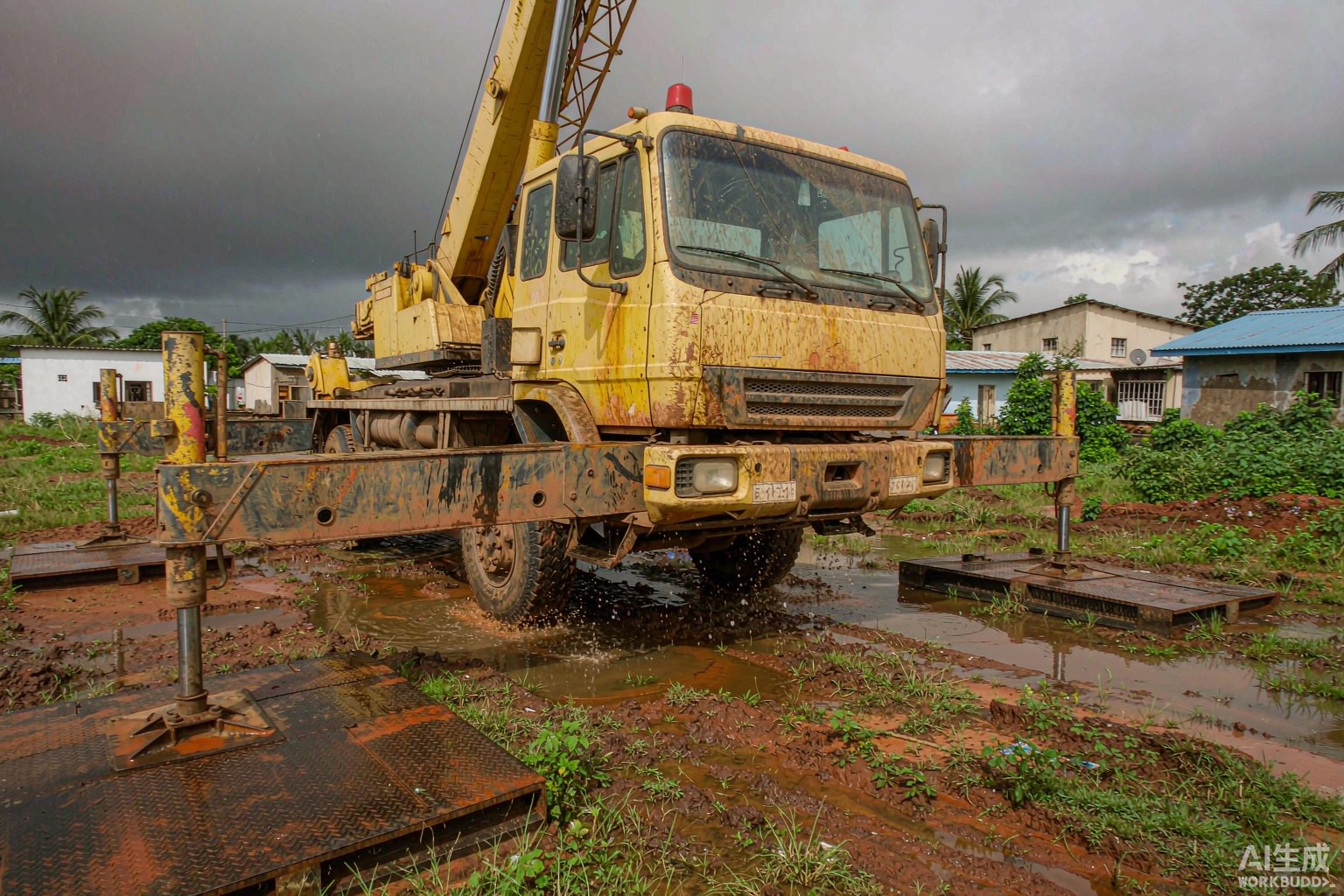
• Ground, not rain, is the main killer: a typical truck crane at full outrigger extension can impose 0.8–1.5 MPa on the ground, and saturated soil can lose bearing capacity within hours. Mats or crane pads are not optional.
• Four evidence blocks for a used machine: electrical sealing and insulation, hydraulic oil condition, wire-rope corrosion and broken wires, and outrigger pads plus parking position. These decide whether it survives a wet season.
• Split responsibility up front: the site supervisor owns the stop-work call and operators have the right to refuse; the seller warrants pre-delivery condition, the buyer owns post-arrival maintenance and setup conditions.
What are the real stop-work thresholds in Mozambique's rainy season?
During the Mozambican rainy season, wind direction can shift abruptly with a cyclone, afternoon thunderstorms build fast, and drainage around low-lying sites and port backyards is slow. Chinese quality-authority guidance for the flood season puts it plainly: all lifting operations must stop in Force 6 or stronger winds, heavy rain, lightning or dense fog. This is not a rule of thumb — GB/T 6067.1-2010 says a crane must not be operated when wind exceeds the manufacturer's specified working wind speed, with the actual figure taken from the machine's data sheet; mobile-crane alarms are commonly set near 12 m/s.Table 1 converts the common thresholds into something a site team can use directly. Every line states when the number applies — "Force 6" means something very different for a short boom lifting a solid block than for a long boom lifting roof sheets.
Table 1. Rainy-season conditions and stop-work lines
Condition | Threshold | When this number applies | Site action |
|---|---|---|---|
Gusts / working wind | Manufacturer's working wind speed first; many mobile cranes alarm at ≈12 m/s; site practice often stops all lifts at Force 6 / 10.8 m/s | Measure at boom tip or upper machine, judge on gusts; large flat loads (steel plate, formwork, roof sheets) controlled at Force 5, 8.0–10.7 m/s | Land the load, stow the boom, turn it downwind, lock slew and brakes, evacuate personnel |
Force 5–6 | No assembly/dismantling of mobile cranes; no lifting of large-volume items such as big formwork | From clause 5.3.10 of the Construction Mobile Crane Safety Management Standard; applies to assembly/dismantling and bulky loads, not every pick | Keep only small routine lifts, or stop entirely |
Force ≥6, or heavy rain / snow / dense fog | Stop all outdoor work; trial lift before resuming, confirming all safety devices respond | "Heavy rain" means sustained rain that impairs visibility and brake friction, not a brief shower | Stop; trial lift before returning to rated load |
Force ≥9 | First secure the machine's stability; full inspection and acceptance before resuming | Same standard, 5.3.10; an out-of-service securing requirement | Stow and anchor the boom, secure the hook; full inspection afterwards |
Visibility | Stop outdoor lifts below 30 m | Insufficient night lighting, or inability to see the signal person or load, is treated as a stop condition | Stop lifting, add lighting or wait for daylight |
Lightning | Stop at the first thunder; resume no earlier than 30 minutes after the last thunder | The boom is often the tallest metal object on site; a strike can damage controls, rope and bearings with no visible signs | Stop and evacuate; suspect strike requires a qualified inspection |
Post-rain ground | Any outrigger sinkage or machine tilt means stop and unload immediately | Typical truck crane at full outrigger spread imposes 0.8–1.5 MPa; saturated soil can lose capacity within hours | Land the load, re-pack the pads, re-level, then trial lift |
Local note: Mozambique's National Meteorology Institute (INAM) issues blue, yellow, orange and red alerts, with the MetMap app for tracking. Nominate one person to check alerts before every shift — in March 2026, heavy rain flooded central Maputo twice in one week, leaving cars stranded. Use the same discipline in our pre-delivery inspection guide: 7 key areas when you check the machine itself.
Which parts of a used crane need rainy-season maintenance?
On a used crane, wet weather amplifies the previous owner's maintenance gaps. Work through four evidence blocks, each with a defined normal state and a defined response:① Electrical and earthing (most often missed)
Check control-cabinet and distribution-box door seals, desiccant or anti-condensation heaters, green oxidation on terminals, and damaged cable sheathing. Moisture lowers insulation resistance and makes contactor contacts rust or stick — the symptoms are jumping gauges and failing controls. Test insulation before wet-weather work, and keep the earthing/lightning connection intact; in storm season that is a requirement, not a bonus.
② Hydraulics (emulsified oil means change it, not top it up)
After rain, check the tank cap, filler neck and pipe unions for water ingress. Milky or sticky oil means stop immediately, change the oil and replace the filter together — topping up only hides the problem while water keeps damaging the pump and valves. Keep the breather clean, change suction filters on schedule, and run holding tests on outrigger lock valves and the luffing cylinder, especially after working on wet ground.
③ Structure and wire rope (corrosion eats load-bearing section)
Wash mud off the boom, pins and outriggers after each rain, and re-grease pivots to form a protective film. Re-tighten slew-bearing and boom connection bolts to the manufacturer's specification, with split pins fully seated. Clean and apply water-resistant lubricant to wire rope, and scrap it under GB/T 5972-2023 (= ISO 4309:2017): broken wires reaching the limit within one lay length (12 for 6×19, 22 for 6×37 rope), diameter wear ≥7%, a broken strand, birdcaging or kinking all mean replacement.
④ Chassis, outriggers and parking (decides whether you work tomorrow)
Never set outriggers directly on rain-soaked ground — use crane mats or adequately sized steel plates. Keep the setup area drained and away from excavations, drains and backfill. At shift end, stow the boom, secure the hook, lock the slew, and park on high, dry, ventilated ground; if outdoor parking is unavoidable, cover with a tarpaulin and stay away from low-lying water. Check tyre pressure and brakes before each wet-weather shift.
Our 10-year on-site inspection methods guide gives the detailed scoring version — combine its hydraulics, chassis and cab/electrical blocks with the rainy-season items above.
What is the correct restart procedure after heavy rain?
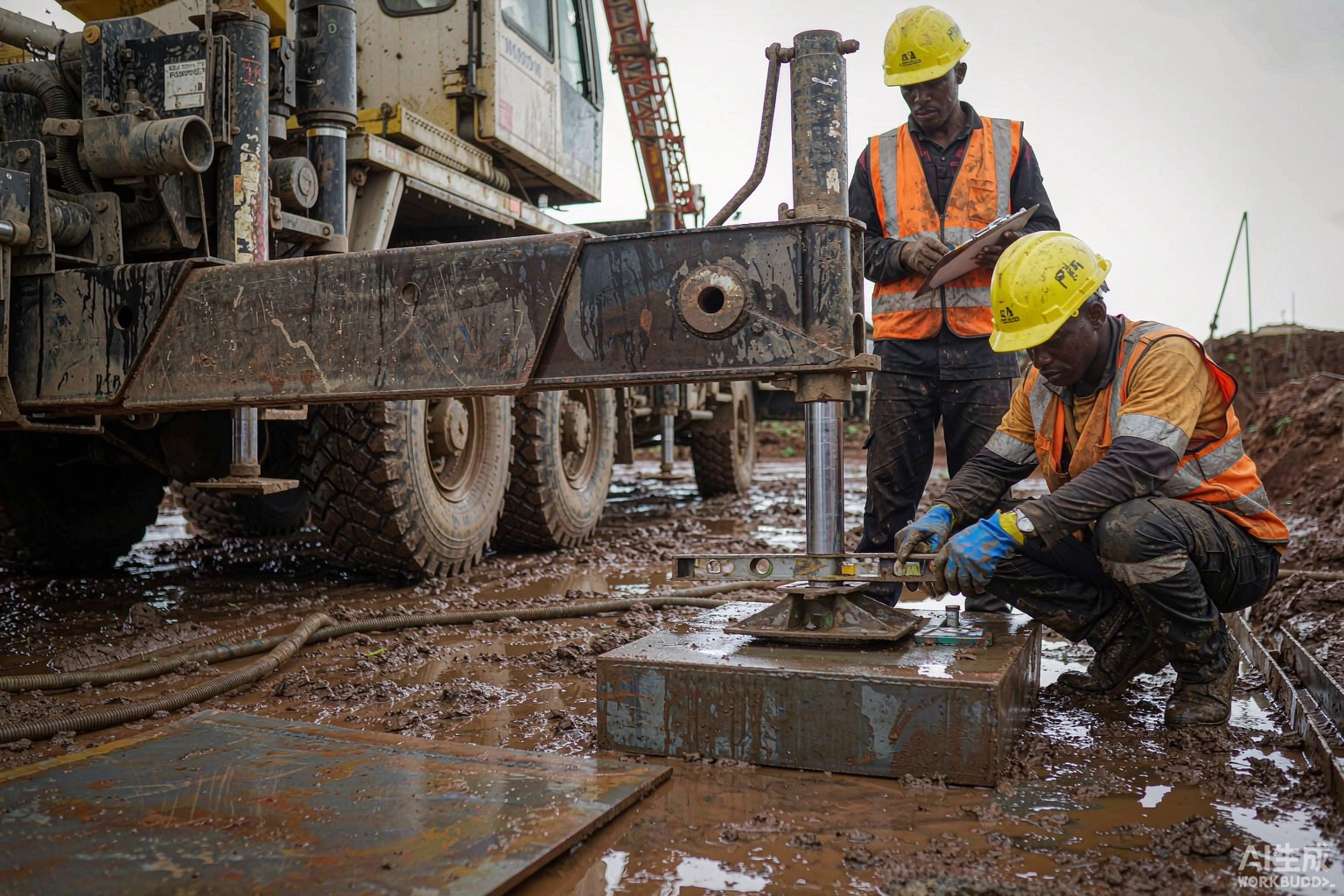
The typical accident sequence is not "lifting during a storm" — it is the rain stops, everything looks fine, and full load goes straight back on. The right order is: confirm the weather window → recheck ground and outriggers → inspect electrics and oil → trial lift → only then resume rated loading. Table 2 breaks the actions down by frequency; print it and keep it in the cab.
Table 2. Rainy-season maintenance and inspection calendar, used truck crane
Frequency | Electrical / safety devices | Hydraulics / fluids | Structure / wire rope | Outriggers / chassis / parking |
|---|---|---|---|---|
Daily, before shift | Insulation and gauge self-check; test limiters and LMI; lights and wipers | Oil level and colour (change if emulsified); visible leaks | Visual broken-wire and corrosion check; hook and pins | Pads in place; no new standing water; tyres and brakes |
After every heavy rain | Open cabinets and check for water; dry before energising | Recheck tank cap and unions; emulsified oil means oil + filter change | Wash off mud, re-grease pins; inspect boom and welds for new cracks | Re-measure outrigger sinkage and machine level, drain and re-pack pads; unload first if sinkage is found |
Weekly | Tighten terminals, check earth continuity and battery posts | Filters and breather; grease exposed cylinder rods | Re-tighten bolts; full rope inspection and lubrication | Wash and dry chassis; grease outrigger cylinder rods |
Before an orange-or-higher cyclone alert | Isolate non-essential power; record machine state | Retract all cylinders and grease exposed rods | Fully retract boom, secure hook, remove loose attachments | Move out of low ground, park downwind, anchor per the manufacturer's out-of-service procedure |
Long-term storage | Desiccant / anti-condensation heater; weekly energisation | Cycle all functions weekly to prevent fluid separation | Re-grease weekly and check corrosion points | Block up, cover with a ventilated tarpaulin |
Make the trial lift a written record: lift once at low height and short radius, confirm the LMI, brakes, slew and outriggers all behave normally, and only then approach rated load.
What are the common rainy-season pitfalls — and who carries the risk?
• Setting outriggers on flooded ground. Rain can wash out soil over culverts and drains; the surface looks firm while the ground beneath is gone. Control: keep outriggers away from excavation edges and drainage paths, use crane mats, and unload immediately if sinkage appears.
• "One last lift" during a thunderstorm. The boom is the tallest point on site, and a strike may damage only internal controls. Control: stop at the first thunder, wait at least 30 minutes after the last, and have a suspected strike inspected by a qualified person.
• Judging a flat-surfaced load by weight alone. Three tonnes of steel plate catches far more wind than three tonnes of solid block. Control: apply the Force 5 rule to flat loads, use taglines, and land the load when wind rises — taglines are not a substitute for stopping.
• Topping up emulsified hydraulic oil. Once water reaches the pump and valves, the damage is irreversible. Control: stop, change oil and filter together, and log the change in the machine file.
• Trusting the hour meter without checking flood and rental history. A previously submerged crane reveals its electrical faults in the wet season. Control: ask for a cold-start video and a statement on storage and repair history, and use third-party inspection where needed — the usual tricks are covered in our used machinery scams guide.
• Returning to full load straight after rain. Dry-looking ground is not proof of restored bearing capacity. Control: run the "after every heavy rain" row of Table 2 and trial lift before loading.
Responsibility boundaries: stop-work authority sits with the site supervisor, and operators have the right to refuse work in over-limit weather — this belongs in the site rules; the seller warrants pre-delivery machine condition and any declared repair history, while the buyer owns post-arrival maintenance, parking and setup conditions. Lease or service contracts take precedence where they state otherwise. Nothing here replaces the manufacturer's manual or statutory inspection requirements.
How we evaluated these thresholds
Stop-work lines come from GB/T 6067.1-2010 (no operation above the manufacturer's working wind speed) and clause 5.3.10 of the Construction Mobile Crane Safety Management Standard (no assembly/dismantling or bulky lifts at Force 5–6; stop outdoor work at Force 6 and above or in heavy rain/fog; secure and re-inspect at Force 9 and above). Wire-rope discard criteria come from GB/T 5972-2023, identical to ISO 4309:2017. Maintenance items are drawn from manufacturers' humid-environment guidance and general crane-industry practice. The Mozambican seasonality, cyclone events and road conditions are based on INAM alerts and public post-disaster reporting for 2025/26, including the March 2026 Maputo flooding and EN1 damage.Data note: the Chinese standards cited are statutory or industry-wide reference points. On a Mozambican site, apply whichever is stricter among the manufacturer's manual, local rules and the project lift plan. An on-site check of a used machine is not a statutory inspection — the substitutes in Table 2 only carry weight if written into the contract. Alert levels, road access and port operations change quickly in cyclone season; re-check the day's information before dispatch.
FAQ
When exactly is the rainy season in Mozambique?Usually from October/November to April, with most of the annual rainfall in that window and cyclones concentrated in January–March. The south around Maputo is relatively drier, but short cloudbursts still flood low-lying urban areas.
Can we keep lifting in light rain?
Only if three conditions hold: wind within the manufacturer's limit, visibility good enough to see the signal person, and outrigger ground neither saturated nor settling. Sustained rain that affects brake friction and visibility is treated as heavy rain — stop, and trial lift after it clears.
How do I tell whether a crane is safe after a thunderstorm?
Check four things: water in the control cabinets, cable insulation, wire-rope condition, and slew/outrigger movement. After a suspected strike — tripping, burning smell, failed controls — do not simply reset and carry on; wait for a qualified inspection.
Should I check for flood history on a used crane?
Yes. Look for water marks and corrosion in the cab and control cabinets, replaced wiring harnesses and oxidised connectors, and ask for a statement on flooding or long-term outdoor storage. These issues stay invisible in the dry season and surface all at once in the rain.
Are steel plates enough under the outriggers?
It depends on the ground. A typical truck crane at full outrigger spread can impose 0.8–1.5 MPa, and a small plate may still be inadequate on saturated soft soil. Use crane mats or engineered pads beside backfill, drains and excavations, and re-confirm after rain.
How do we plan a schedule around wet-season stoppages?
Put heavy, bulky and long-radius lifts in the best weather windows; use light-rain days for maintenance, repairs and yard moves; and anchor the machine to the manufacturer's out-of-service procedure at orange alerts or above. The 2025/26 season also damaged trunk roads including the EN1 and lengthened overland transit — build buffer into equipment and crew mobilisation.
Sources
• China Quality News (quoting Shanghai Market Supervision Administration) — flood-season crane safety guidance: https://www.cqn.com.cn/ms/content/2022-09/15/content_8861265.htm
• Jintang County Government — 2026 flood-season special-equipment safety notice (crane section): https://www.jintang.gov.cn/jtxscjgj/gzdt/2026-08/07/content_688d2bca70c54d11bebc192220e00bc7.shtml
• Construction Mobile Crane Safety Management Standard, clause 5.3.10 (adverse weather): https://zjjcmspublic.oss-cn-hangzhou-zwynet-d01-a.internet.cloud.zj.gov.cn/jcms_files/jcms1/web3162/site/attach/0/1100ad11dbf646efbaef93051d194e31.pdf
• Luoyang Chen'an — How weather affects crane operations (wind, visibility, ground): http://www.lycadz.com/newShow.aspx?xwxq=668
• HUGECRANE — Rainy Season and Moisture Protection Maintenance: https://www.hugecrane.com/news/rainy-season-and-moisture-protection-maintenan-85598135.html
• Hoists and Cranes — Monsoon Maintenance and Safety Checklist: https://www.hoistsandcrane.com/blog/monsoon-maintenance-and-safety-checklist-for-industrial-eot-cranes
• The Crane School — Crane Safety Tips for Extreme Weather Conditions: https://thecraneschool.com/blog/crane-safety-tips-for-extreme-weather-conditions
• Club of Mozambique / Lusa — Maputo flooding and INAM alerts, March 2026: https://clubofmozambique.com/?p=165791
• TravelNews Africa — 2025/26 floods and cyclones: infrastructure impact, 2026: https://travelnews.africa/news-single.html?id=18403
• Priority Worldwide — Mozambique Floods 2026 Sitrep (road access, VAT 16%): https://priorityworldwide.com/mozambique-floods-2026-sitrep-1
Published: 2026‑11‑24
Last reviewed: 2026‑11‑24
Author: 【Flora He 】Equipment Inspector, FairTradeMachinery






 Живой чат в Whatsapp сейчас


 FAQs
 WhatsApp