Inspecting a Used Truck Crane On-Site: Which Parts Should You Check First? (12 Critical Points with Pass/Fail Criteria)
Quick Answer: Bring four things to the yard — a bright flashlight, a paint thickness gauge, a pry bar, and a phone that records everything. Work in the order structure → hydraulics → safety devices → chassis → paperwork: on the boom, judge the welds and boom-pin play, not the paint; on the outriggers, run a holding test; judge the wire rope against GB/T 5972 (identical to ISO 4309:2017 — discard at 7% diameter reduction or over-limit broken wires); and verify the load moment limiter by lifting a known weight. Load-path weld cracks, visible slewing-bearing play, and a failed moment limiter are walk-away items; tires, wire rope and respray are price-deduction items.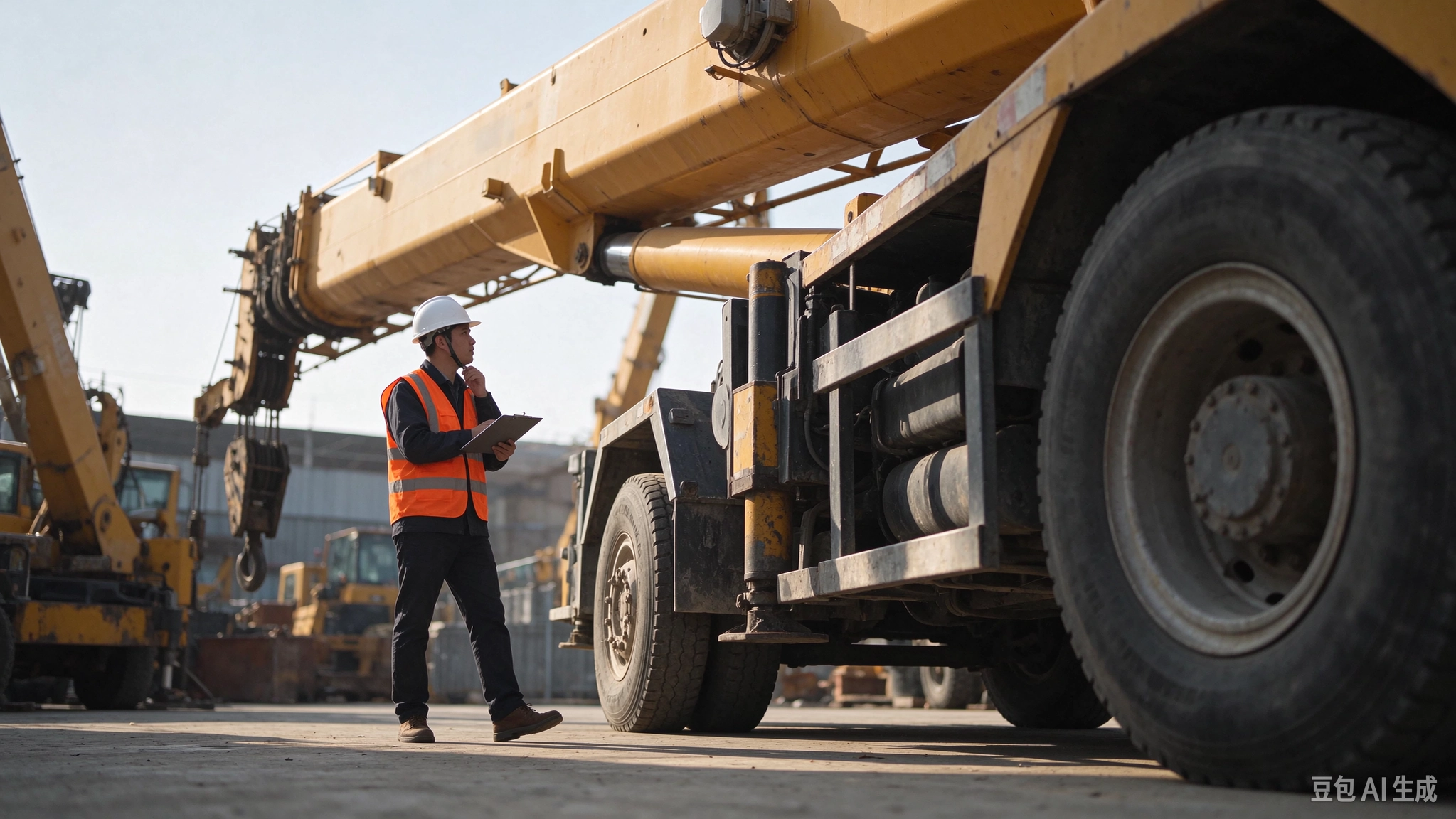
Key Takeaways:
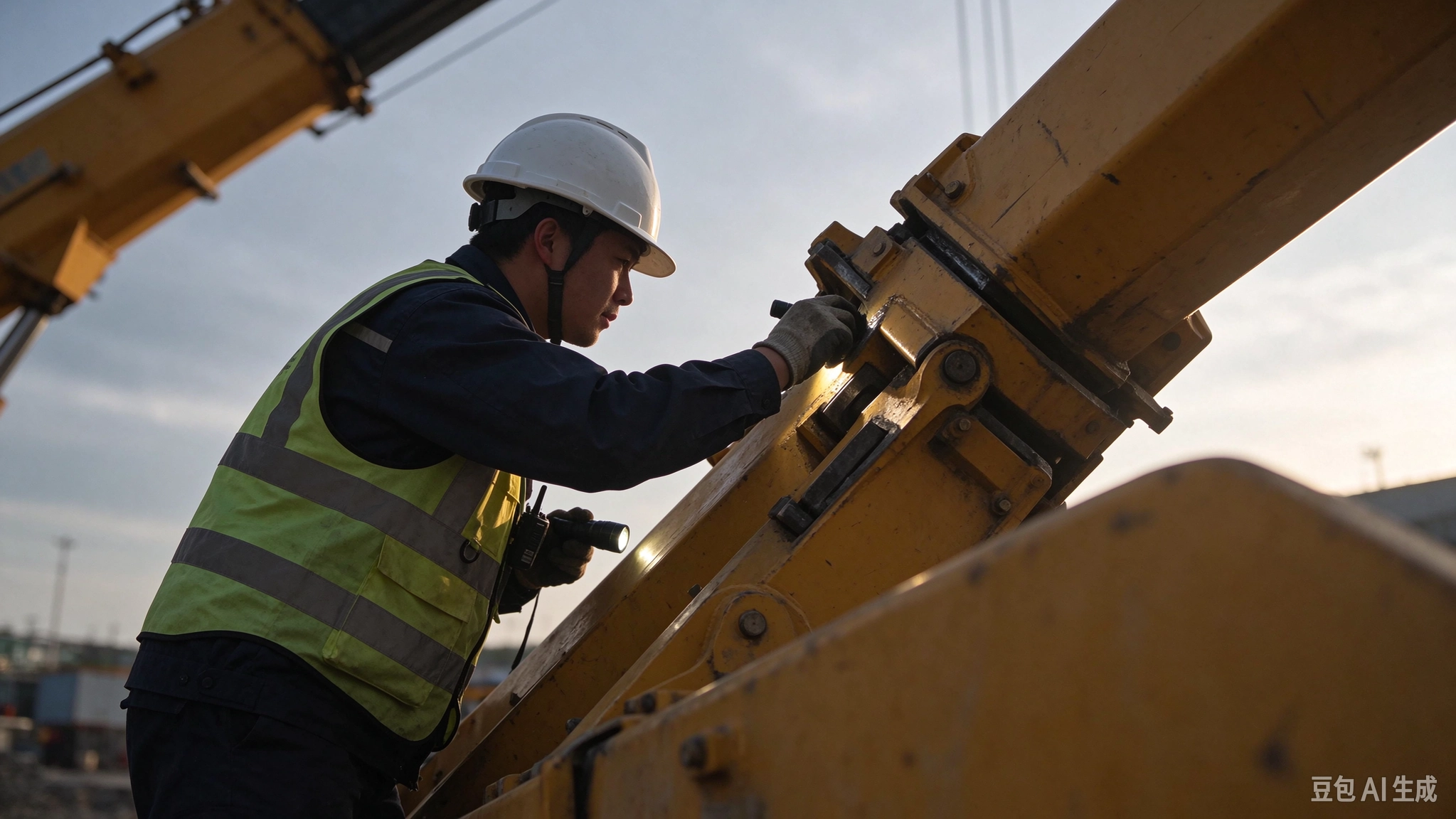
• Boom inspection is weld inspection: factory welds are uniform and continuous; repairs show disturbed ripples and abrupt paint-thickness changes — sweep the gauge along both sides of every weld, not the flat panels.
• Outrigger check means a holding test: extend the vertical cylinders fully and let them stand 30 minutes; professional acceptance criteria allow no more than 0.5% pressure loss in 30 minutes — visible sinking or dripping on-site is a fail signal.
• Wire rope: discard at over-limit broken wires in one lay length, ≥7% diameter reduction, a broken strand, birdcaging or kinking (GB/T 5972-2023 / ISO 4309:2017); valley breaks count double (EN 13001-3-2 Annex B).
• The load moment limiter (LMI) is the machine's lifeline: TSG Q7015-2016 requires motion cut-off at 1.05× rated moment; lift a known test weight on-site — error beyond ±5% is a walk-away.
• Every number has conditions: broken-wire limits vary by rope construction (6×19 vs 6×37), and the 1.25× static load test is a periodic-inspection criterion — a used-crane buyer substitutes a known-weight lift, which must be written into the contract to count.
In what order should you inspect, and what tools do you need?
Order matters because structural repairs are irreversible while hydraulics and rubber items are replaceable — beginners look at the cab and paint first; professionals start with steel.Recommended sequence (2–3 hours):
1. Paperwork first (10 min): match the nameplate, chassis number and engine number against the contract; check certificates and registration. A chassis-number mismatch ends the inspection there.
2. Structure (60 min): boom, turntable, chassis frame, outrigger beams — welds, cracks, repairs, deformation.
3. Hydraulics (30 min): pumps, cylinders, valves, hoses, oil condition.
4. Safety devices (20 min): moment limiter, over-hoist limit, radius indicator.
5. Function test (30 min): cold start, full no-load cycle, loaded lift if the site allows.
6. Chassis and cab (20 min): engine, gearbox, tires, and interior wear cross-checked against hours.
Tool list: bright flashlight, paint thickness gauge, pry bar, wire-rope caliper or vernier caliper, tape measure, magnifier, chalk or marker (flag suspects), phone (record everything, shoot numbered close-ups of each area).
The recording is not just evidence: when you send footage to a third-party inspector or back home, one clip of visible play or one oil stain often becomes the basis of your price negotiation — the same discipline as the video timeline we require for remote inspection of used machinery.
How do you judge the boom, slewing bearing and outriggers?
Table 1. Judgment criteria by component — pass / walk away / deduct (basis per metadata)Component | What to check | Pass | Walk away | Deduct from price |
|---|---|---|---|---|
Boom sections | chord welds, lower-face scoring, head sheaves | Uniform, continuous, unrepaired welds | Cracks in load-path welds or unrepaired welds without NDT report | Over-thick local paint, worn sheaves |
Boom pins & bushings | pry-bar play, pin wear | Play barely visible | Obvious play, loose bushings both sides | One-side bushing wear (replaceable) |
Telescope cylinder | loaded stand test, rod scoring | No visible sink in 10 min | Deep rod scoring, continuous sink under load | Minor weeping — new seals fix it |
Slewing bearing | full-sweep noise, tooth pitting | Smooth, quiet sweep | Visible play or missing teeth | Light pitting — re-lubricate and recheck |
Turntable & frame | root of turntable, frame-rail inner faces | No cracks, factory condition | Frame cut-and-welded, turntable-root cracks | Locally straightened deformation |
Outriggers | holding test, beam-root welds, pads | No sink or seepage in 30 min | Cracks at beam roots | Seals and pads |
Wire rope | broken wires, diameter, deformation, lubrication | Below GB/T 5972 discard limits | Broken strand, birdcage, kink, ≥7% diameter reduction | Near-limit rope — re-rope at length price |
Hook | throat opening, twist, saddle wear | Opening growth <15%, twist <10% | Over either limit (periodic-inspection discard criteria) | Replace hook — low cost |
Moment limiter (LMI) | test lift, alarm and cut-off | Cuts motion at 1.05× rated moment, error ≤±5% | Missing, dead, or unverifiable | Sensor drift — recalibration |
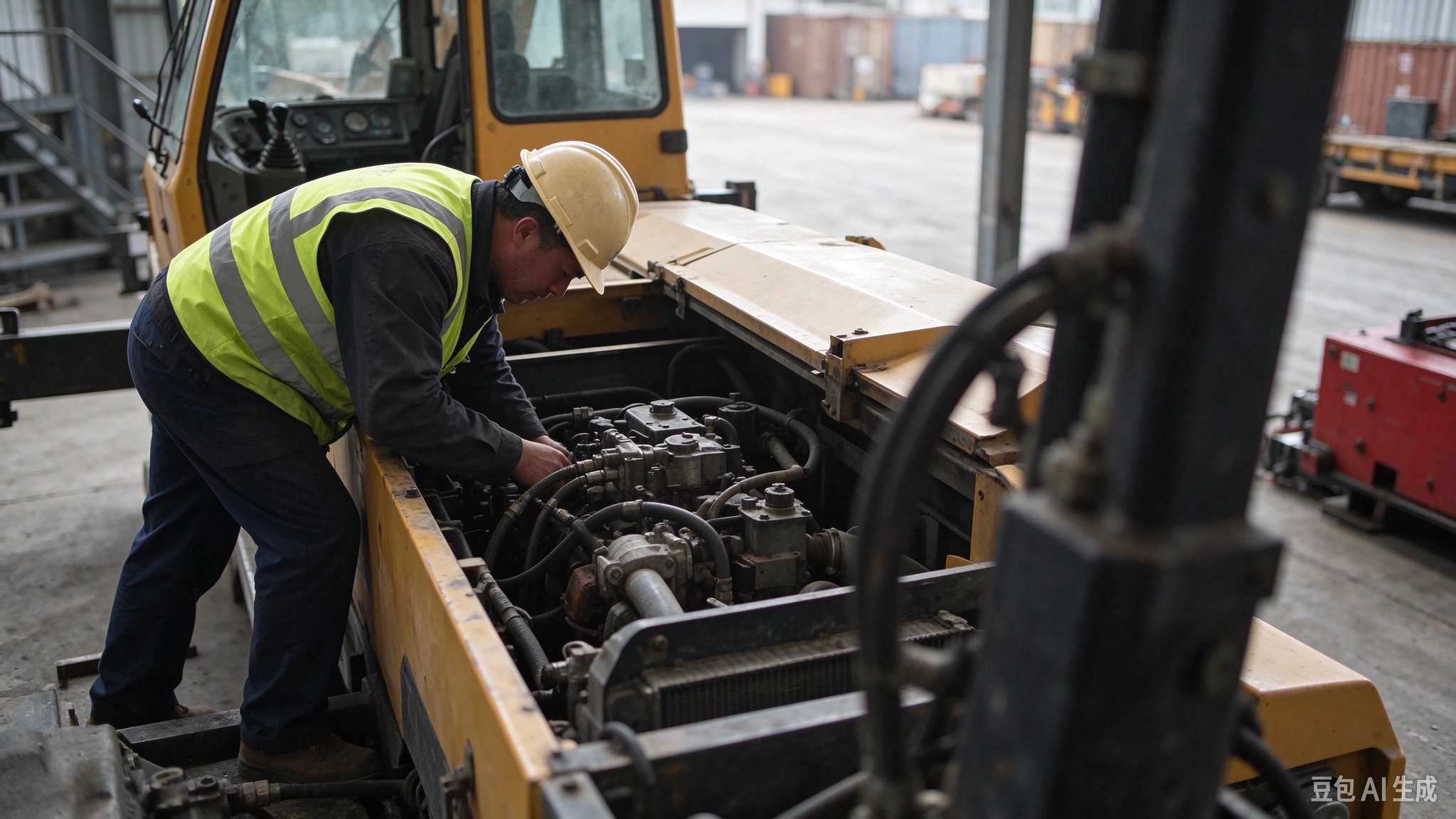
Hydraulics | pump case drain, hose cracking, oil cleanliness | Smooth motion, sound hoses | Noisy pump with heavy case drain, overheating | Batch-aged hoses, minor leaks |
Chassis | cold start, gearbox, tires | Starts first try, matched tires | Blue smoke after rebuild, gearbox slip | Tires, batteries at usage cost |
Cab & electronics | A/C, displays, camera, joystick wear | Complete, wear matches hours | Display contradicts moment values | Aging trim |
Three common misreads: first, paint — a whole machine with factory-fresh paint is a warning, not a plus; sweep the gauge along weld edges, not flat panels (factory crane paint generally runs 80–120 μm; a spot reading over 2× that flags a repair). Second, hours — hour meters can be rolled back; cross-check pedal rubber, seat bolsters, joystick knobs and tire dates. Third, counterweight — count blocks against the factory manual; non-original or missing blocks invalidate the rated-capacity chart exactly when you need it.
What are the common scams, and how do you spot them on the spot?
Table 2. Common frauds on used cranes and field detection (ordered by frequency)Fraud | How to detect on-site | What to do |
|---|---|---|
Full respray hiding cracks and leaks | Paint gauge along welds and edges — factory paint ~80–120 μm, a spot 2× thicker is a suspect | Demand paint removal + NDT, else deduct repair cost |
Rolled-back hour meter | Pedal rubber, seat bolsters, joystick wear vs. hours; tire dates later than registration | Reconstruct hours from wear; write the estimate into the contract |
Mixed boom sections from different units | Section numbers vs. nameplate; inconsistent paint and corrosion; boom length off spec | Walk away — the load chart is meaningless |
Missing or non-original counterweight | Count blocks and per-block weight marks against the manual; check pins | Deduct replacement cost, write block count into contract |
Ground-down welds filled with sealant | Raking flashlight on weld ripples; scrape the filler; listen for dull knock | Demand magnetic-particle test, else treat as cracked |
Accident unit cut and re-joined | Frame-rail inner faces — cut welds, fresh metal color mismatch | Walk away — structural splicing is irreversible |
Hidden rental-fleet history | Ownership changes on certificates, maintenance-record gaps, old fleet-number ghosts | Require service records before pricing |
The logic is the same as in our used machinery scams exposed guide: fraudsters bet that buyers judge by appearance and price. Arrive with a gauge and a pry bar, record everything, and ask "under what condition does this number hold?" — the fraud becomes unprofitable.
Which findings mean walk away, and which are price deductions?
Walk away (irreversible or unverifiable):• Cracks in load-path welds, or repairs the seller refuses to NDT-test
• Visible slewing-bearing play or missing teeth
• Moment limiter missing, dead, or unverifiable
• Mixed boom sections, or a frame rail cut and re-joined
• Chassis number or nameplate mismatching the contract
Price deductions (repairable — subtract the repair cost):
• Wire rope near the discard limit: full re-rope, priced by diameter and length plus fitting labor
• Outrigger or cylinder seal leaks: seals plus labor
• Batch-aged tires: per tire, by size
• Single-side bushings, worn sheaves: parts plus labor
• Trim and minor electrics: actual replacement cost
The rule is that every deduction needs written backing: list each defect in a contract annex with either "deducted against repair invoices" or "deducted at the agreed estimate," so nothing is argued after delivery. This mirrors the contract wording in our 7 key areas to check before buying guide.
How we set these criteria
The numeric basis is public standards: wire-rope discard follows GB/T 5972-2023 (identical to ISO 4309:2017), whose broken-wire limits vary by rope construction and lay length, with the double-counting of valley breaks from EN 13001-3-2 Annex B; the 1.05× moment-limiter test, hook opening 15% / twist 10% discard, and the 1.25× static load held 10 minutes come from TSG Q7015-2016 and TSG 51-2023 periodic-inspection criteria; the 0.5% pressure loss in 30 minutes is the common acceptance figure used by special-equipment inspection bodies. Paint-thickness benchmarks and the wear-vs-hours cross-check come from field experience. Note: TSG criteria are statutory requirements for in-service special equipment; a used-crane buyer rarely has the same test conditions on-site, so this article gives substitute methods — and substitutes only count when written into the contract. This article is not a safety certification; for major purchases, commission a qualified special-equipment inspection body.FAQ
The seller only offers video — what then?Acceptable if the video covers four items: full cold start, boom extend/retract under load, outrigger cycle, and close-ups of the chassis number and nameplate — plus a third-party inspection report. Missing either, walk away. Video credibility comes from mapping every shot to Table 1.
The seller won't allow a test lift.
Common — many yards have no test weights. Substitute: full no-load function test + outrigger holding test + LMI power-on self-check. A seller who refuses even no-load motion is signaling a problem; walk away.
Can I trust the hour meter?
Treat it as untrusted by default. Cross-check pedal rubber thickness, seat bolster collapse, joystick wear, tire and battery dates; a gap over ~30% means price the machine as if the meter were blank.
What extra checks does a 10-year-old crane need?
Three: metal fatigue (magnetic-particle testing of welds has the highest value), batch hydraulic-hose aging (replace even without visible leaks), and the calibration/inspection record trail of the safety devices. A 10-year-old unit with missing periodic-inspection records should be priced as carrying hidden defects.
How do I make inspection findings enforceable in the contract?
List each defect with its deduction ("against repair invoices" or "at the agreed estimate"), set staged payment (e.g., 30% deposit, balance against rectification evidence), and define delivery condition: counterweight block count, wire-rope status, LMI calibration result. Verbal promises are worth nothing.
Sources
• GB/T 5972-2023 Cranes — Wire ropes — Care, maintenance, inspection and discard (identical to ISO 4309:2017) — broken-wire, 7% diameter-reduction and deformation discard criteria
• ISO 4309:2017: https://www.iso.org/standard/65577.html
• TSG Q7015-2016 Crane Periodic Inspection Rules (Fujian market-regulation authority public text; 1.05× moment-limiter test, load tests): https://scjgj.fujian.gov.cn/zt/tzsbxzxkggzl/zzwj/202104/P020210430573653523218.pdf
• TSG 51-2023 Safety Technical Regulation for Lifting Machinery (mobile-crane special test criteria)
• EN 13001-3-2:2014 Annex B (valley breaks counted double)
• Mobile-crane inspection item lists from special-equipment inspection bodies: https://www.beijiance.com/qt/qt/178287
Published: 2026‑11‑18
Last reviewed: 2026‑11‑18
Author: 【Flora He 】Equipment Inspector, FairTradeMachinery






 Живой чат в Whatsapp сейчас


 FAQs
 WhatsApp