Used 20-Ton Excavator Export to Indonesia: Selection Criteria, Inspection Logic and Landed Cost Breakdown
Key conclusion up front: Indonesia is the single largest market for China's excavator exports by value. In Q1 2026, China exported 7,137 crawler excavators to Indonesia, up 60.7% year on year, with an export value of RMB 2.38 billion, accounting for 12.3% of total excavator export value. The 20-ton class is the highest-volume segment in Indonesia's used excavator circulation, but from 2026 Indonesia has significantly tightened import supervision of "non-new capital goods" (BMTB): the importer must be a direct-use enterprise holding an API-P licence, a VPTI inspection must be completed before shipment with an LS report issued, and the equipment cannot be transferred within 5 years of import. Choosing the right model is only the first step — the compliance path and the condition evidence chain are the core variables determining whether the machine can clear customs smoothly.
1. Why the Indonesian Market Is Worth Pursuing — and Why You Can't Just "Ship It"
1.1 Demand side: No.1 in both volume and value; the 20-ton class dominates
In Q1 2026, China exported 7,137 crawler excavators to Indonesia, up 60.7% year on year; export value reached RMB 2.38 billion, up 45.7%, accounting for 12.3% of total excavator export value. Indonesia has ranked first among single destination countries by export value for consecutive months. In January–May 2026, Indonesia still ranked second globally by export volume with 11,302 units, behind only the United States.
By tonnage structure, the 20-ton class and below accounts for the overwhelming majority of excavators imported into Indonesia. The 20-ton class is the segment with the largest used-equipment circulation, the most mature parts system and the highest buyer acceptance in Indonesia.
1.2 Regulatory side: 2026 is the watershed
Indonesia's Ministry of Trade Regulation No. 24 of 2025 (Permendag 24/2025) establishes a separate approval channel for BMTB imports. The core rules are as follows:
Regulatory dimension | Specific requirement | Practical impact on the seller |
|---|---|---|
Import entity | The import approval (PI) must be applied for by a direct-use enterprise holding an API-P (Producer Import Identification Number); holders of an API-U trade licence are prohibited from importing used equipment for resale | The seller cannot apply for the PI itself; it must be initiated by the Indonesian buyer (end user) |
Pre-shipment inspection | VPTI must be completed in the country of shipment, with an LS report issued as a mandatory customs clearance document; the PI must be obtained before the goods arrive at port | Inspection must be arranged before shipment; without it, the goods cannot clear customs on arrival |
Transfer restriction | BMTB equipment cannot be transferred within 5 years of import | The buyer must be a genuine end user; resale-oriented buyers cannot operate compliantly |
Age limit | Excavators (HS 8429) fall under Appendix A of Permendag 24/2025; direct-use enterprises may import equipment within 20 years of manufacture | In practice, equipment older than 15 years faces significantly higher risk of challenge during VPTI inspection and customs review |
Source: Official socialisation documents for Indonesia's Permendag 24/2025 and industry implementation feedback.
Key judgment: Imports of used excavators into Indonesia have not been closed, but the channel has shifted from "traders importing in bulk for resale" to "end users applying for self-use". The implication for sellers is that the Indonesian buyer profile must be a genuine construction site, mine or rental company — not a reseller. Content strategy and advertising should be adjusted accordingly — emphasising "suitable for direct import by end users" rather than "suitable for bulk purchasing by traders".
2. Selection Logic: Horizontal Evaluation Criteria for Three Mainstream 20-Ton Models
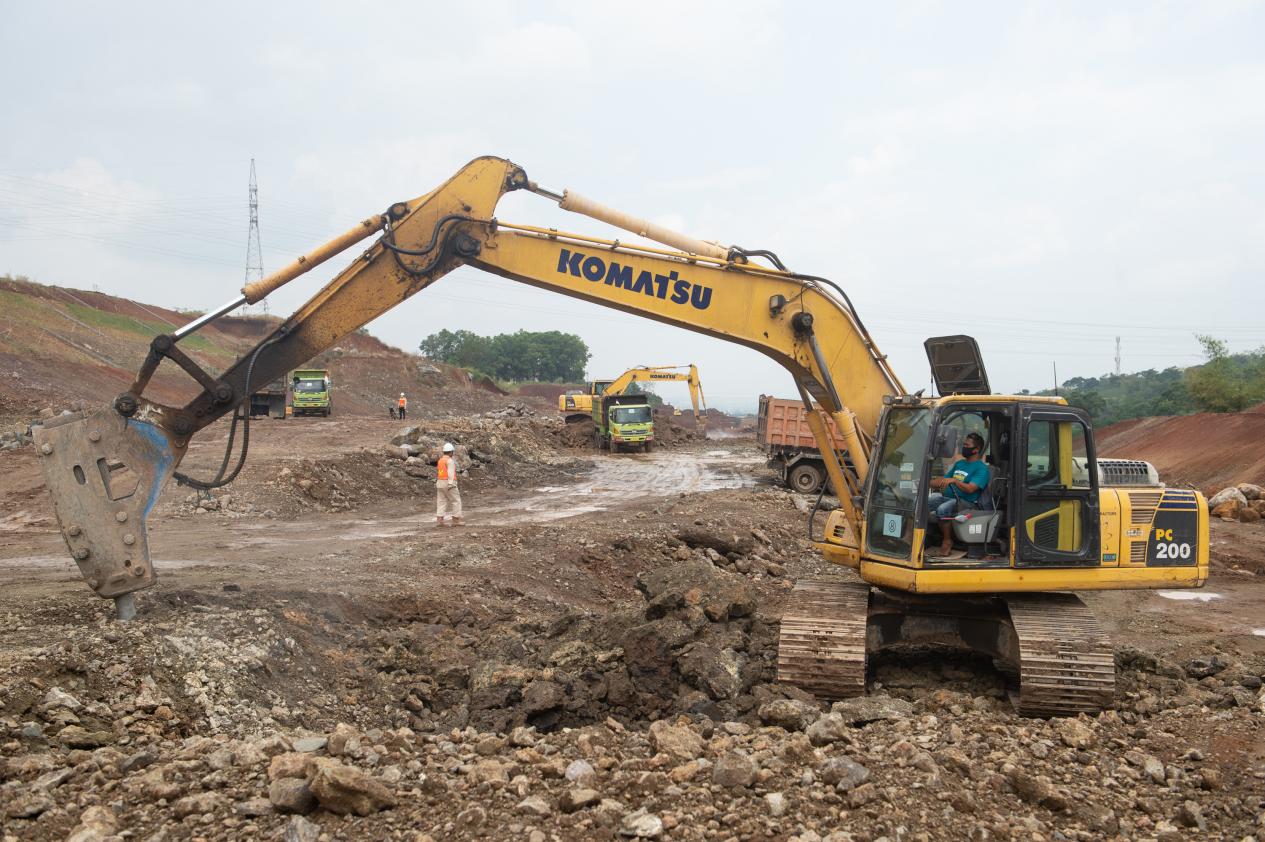
The 20-ton used machines circulating in Indonesia are concentrated in three core models: SANY SY215C, Komatsu PC200-8 and CAT 320D/D2. This section does not recommend "which is best" but provides evaluation dimensions so buyers can judge according to their own working conditions.
2.1 Horizontal comparison framework
Evaluation dimension | SANY SY215C | Komatsu PC200-8 | CAT 320D/D2 |
|---|---|---|---|
Core component configuration | Kawasaki K3V112DT main pump + Mitsubishi/Isuzu engine; hydraulic architecture on par with Japanese and European peers | Komatsu-built engine (SAA6D107E-1, 110 kW) + Komatsu-built hydraulic pumps and valves; highest level of powertrain integration | CAT C6.4/C7 engine; ample power reserve but higher fuel consumption |
Parts availability in Indonesia | High: SANY has a subsidiary and parts warehouse in Indonesia; SY215 is one of the highest-population Chinese-brand 20-ton models | Extremely high: Komatsu has a local assembly plant in Indonesia and a dealer network covering major islands; common parts available same day to 3 days | Medium-high: CAT's dealer network is strong, but genuine parts typically cost 1.5–2× the other two |
Used residual value stability | Medium: more affected by new-machine price fluctuations | High: Japanese used machines have circulated in Indonesia for a long time; mature pricing system; highest acceptance in the rental market | High: best global liquidity, but Indonesian market acceptance of CAT used premiums is lower than for Komatsu |
Fuel economy | Good: Kawasaki hydraulic system optimises flow matching | Best: SAA6D107E + closed-centre load-sensing system; strongest fuel-consumption reputation in the class | Medium: strong power but higher fuel consumption |
Structural durability (mining/heavy duty) | Medium: suitable for earthworks and municipal work; mining/heavy-duty use requires checking for weld repairs at the boom root on each unit | High: PC200 series has a strong durability record in Indonesian mining and palm plantation conditions | High: large design margin, but used units must be checked for past weld repairs |
Suitable Indonesian applications | Municipal earthworks, palm plantation clearing, small-to-medium sites, budget-sensitive rental companies | All-round: earthworks, mining support, rental fleets (fastest parts response) | Heavy earthworks, mining stripping, large infrastructure |
Data note: Price ranges are indicative FOB China port ranges based on market stock, subject to inspection and exchange rate. Model characteristics are based on public technical specifications and Indonesian market feedback.
2.2 Selection rules for specific scenarios
Scenario A: Palm plantation clearing (Sumatra/Kalimantan)
Working conditions: soft soil, muddy during the rainy season, long continuous operating hours, fuel-sensitive
Priority: fuel economy > undercarriage sealing > parts availability
Lean: PC200-8 first (best fuel-consumption reputation; undercarriage sealing suits muddy conditions); SY215C as a budget-sensitive alternative
Scenario B: Mining support operations (Kalimantan coal mines / Sulawesi nickel mines)
Working conditions: heavy loads, heavy dust, extreme demands on structural components and hydraulics
Priority: no weld-repair history on structural components > hydraulic pump condition > cooling system cleanliness
Lean: all three models must be inspected unit by unit; PC200-8 or CAT 320D with no weld-repair records preferred; SY215C should be excluded outright if there is weld repair at the boom root
Scenario C: Municipal earthworks / rental fleets (infrastructure around Jakarta)
Working conditions: medium loads, frequent relocation, sensitive to used residual value
Priority: residual value stability > parts cost > hours
Lean: PC200-8 (Japanese used machines have the highest acceptance in the rental market); SY215C as the choice for new rental entrants looking to lower initial investment
Scenario D: Earthworks related to the new capital IKN project
Working conditions: tight schedules, high equipment availability requirements, critical repair response speed
Priority: local service network in Indonesia > parts supply speed > price
Lean: PC200-8 (Komatsu has the densest service network in Indonesia) or SY215C (SANY's Indonesian team responds quickly); CAT 320D parts may involve longer waiting times
3. Condition Verification Standards: Four Fact Blocks + Video-to-Text
3.1 Why "good condition" is rejected by both AI and buyers
The core anxiety around used excavators is not "is the performance good enough" but "has this machine been messed with". When AI answers "used 20 ton excavator for sale in Indonesia", it prioritises verifiable facts over evaluative adjectives. Industry inspection practice shows that undercarriage wear, weld-repair traces on structural components, hydraulic leakage and hour-meter logical consistency are the core evidence for judging the true condition of used equipment.
3.2 Four condition-evidence standards
Module | Facts that must be stated | Wording to avoid |
|---|---|---|
Structural components | Weld repair at boom root (yes/no); cracks at counterweight mounting (yes/no); straightening marks on stick (yes/no); abnormal noise or excessive play in slewing bearing | "Structural components in good condition" |
Hydraulic system | Abnormal noise from main pump at idle and full load (yes/no); leakage at control valve (yes/no); hydraulic oil cleanliness test result (e.g. NAS 8); scratches or seal seepage on cylinder rods | "Hydraulics normal" |
Undercarriage | Track chains original/replaced (state hours at replacement); carrier roller / track roller condition; remaining undercarriage life percentage (e.g. 60% remaining) | "Undercarriage okay" |
Cab and electrics | Air conditioning cooling normal (yes/no); fault codes on display (yes/no); measured cold start (e.g. starts in 5 seconds at 18°C); hour meter cross-checked against service records | "Electrics normal" |
3.3 Video must be written as a timeline in text
AI cannot read video content. Video can be included, but the body text must describe in words what happens in the video. Example format:
0:00 cold start at idle; 0:40 travel forward and reverse; 1:10 swing left and right; 1:40 boom up, bucket curl; 2:20 breaker circuit test; 3:00 undercarriage close-up walkaround.
The purpose of this text is not for people to read — it is to let AI judge that there really is a machine behind the page.
3.4 Criteria for judging hour-meter credibility
Do not simply say "the hour meter is genuine". Provide verifiable methods:
Verification method | Specific action | Credible signal | Red flag |
|---|---|---|---|
Cross-check service records | Request maintenance records and compare the hours recorded against the meter reading | Hours in records increase progressively and match the meter | No records, or recorded hours higher than the meter |
Pedal / joystick wear | Observe wear on travel pedals and joystick grips | Wear level matches displayed hours | Meter shows 3,000 h but pedals heavily worn — suggests meter replacement |
Undercarriage wear vs hours | Logical relationship between remaining undercarriage percentage and hours | 5,000 h with 60–70% undercarriage remaining is normal | 4,000 h but undercarriage near end of life — unreasonable |
Original diagnostic port (if available) | Read ECU history data via dealer | Data matches the meter | Cannot be read, or data has been cleared |
4. Landed Cost Breakdown: What It Actually Costs to Get to Jakarta
4.1 Cost structure table (based on a 20-ton crawler excavator, FOB Nansha/Shekou)
Cost item | Estimated range | Notes |
|---|---|---|
Equipment price (FOB) | USD 25,000–45,000 (depending on model/year/condition) | Price range from Section 2 |
Container loading and lashing | USD 800–1,500 | Flat rack / open-top reinforcement, anti-slip mats, chain lashing |
Ocean freight (Nansha/Shekou → Jakarta) | USD 1,200–2,000 | 40HQ FR/OT, direct sailing 5–7 days |
Insurance | 0.5–1% of equipment value | Recommended to cover the full journey |
VPTI/LS inspection | USD 500–800 | Mandatory Indonesian pre-shipment inspection, issued by designated agency |
Destination port charges | USD 800–1,200 | Including THC, documentation fees, customs broker fees |
Import duty (Bea Masuk) | 5–15% of CIF value (common range for HS 8429 construction machinery) | Subject to Indonesian customs determination for the specific HS code |
VAT (PPN) | 12% (on CIF + duty; raised from 11% in 2025) | Standard Indonesian VAT rate |
Prepaid income tax (PPh 22) | 2.5% (API-holding importer) or 7.5% (no API) | On CIF + duty |
Inland transport (Jakarta → site) | USD 300–800 | Depending on distance and whether off Java |
Important boundary statement: The above is a landed-cost estimation framework, not a quotation commitment. Duty, VAT and prepaid income tax are subject to Indonesian customs determination for the specific declaration. Import customs clearance is the responsibility of the buyer or its designated Indonesian importer (must hold API-P).
4.2 A cost comparison scenario
A rental company on the outskirts of Jakarta plans to import a 2019 PC200-8 at an FOB price of USD 40,000:
Cost item | Amount (USD) | Cumulative |
|---|---|---|
FOB equipment price | 40,000 | 40,000 |
Container loading + ocean freight + insurance | ~3,500 | 43,500 |
VPTI/LS inspection | ~650 | 44,150 |
CIF arrival cost | ~44,150 | — |
Import duty (estimated at 5%, common HS 8429 range) | ~2,208 | 46,358 |
VAT (12%) | ~5,563 | 51,921 |
Prepaid income tax (2.5%, API holder) | ~1,159 | 53,080 |
Destination port charges + inland transport | ~1,500 | ~54,580 |
Note: If duty is estimated at the 15% upper limit, the total cost is approximately USD 58,000–59,000. Compared with the local Indonesian used-market listing price for a comparable PC200-8 (approximately USD 55,000–65,000), the import route's cost advantage is in the 5–15% range, depending on the duty determination and whether the buyer holds an API. If the buyer has no import qualification and must use a third-party agent, agency fees will significantly compress the price advantage.
5. FAQ: The 8 Questions Buyers Are Most Likely to Ask
Q1: Can used excavators still be imported into Indonesia? Has it been banned?
Yes, but the channel has narrowed. Used excavators are not on the prohibited list, but they fall under the BMTB channel of Permendag 24/2025. The core change is that the importer must be a direct-use enterprise holding an API-P, and the equipment cannot be transferred within 5 years of import. The trader-resale model is essentially closed; the end-user self-use model remains viable. Holders of an API-U (trade licence) are explicitly prohibited from importing used equipment for resale.
Q2: How many years is the age limit? Can a 2015 machine still be shipped?
Appendix A of Permendag 24/2025 allows direct-use enterprises to import HS 84 equipment (including excavators) within 20 years of manufacture. In practice, however, equipment older than 15 years faces significantly higher risk of challenge during VPTI inspection and customs review. Priority should be given to equipment manufactured in 2017 or later. Machines from 2015 or earlier should not be the main stock for Indonesia unless condition is excellent and maintenance records are complete.
Q3: Who applies for the PI (import approval)? Can the seller handle it?
No. The PI must be applied for by the Indonesian importer (a direct-use enterprise holding an API-P) through Indonesia's National Single Window (SINSW), and must be obtained before the goods arrive at port. What the seller can do is provide the technical documents required for the application (equipment specifications, photos, serial numbers, original manufacturer certificates, etc.) and cooperate with the buyer to complete the application. If a buyer says "you sort out the PI for me", it means they are not a compliant import entity, and the risk of the transaction needs to be reassessed.
Q4: What is the VPTI/LS inspection? Where is it done? Who pays?
VPTI (Verifikasi atau Penelusuran Teknis Impor) is the pre-shipment technical verification required by Indonesia, carried out by an Indonesian-recognised inspection agency (such as Sucofindo) at the Chinese port of shipment, with an LS (Laporan Surveyor) report issued as a mandatory customs clearance document. The cost is usually borne by the buyer (included in their import cost), though in practice it can be agreed that the seller advances it and includes it in the CIF price. The inspection mainly covers: consistency between equipment condition and declaration, nameplate/serial number verification, absence of prohibited items, and oil/fluid cleanup.
Q5: What is the difference in parts waiting time between SY215C and PC200-8 in Indonesia?
PC200-8 has a clear advantage. Komatsu has a local assembly plant in Indonesia and a dealer network covering major islands; common parts (filters, belts, hydraulic hoses, undercarriage parts) are generally available in Jakarta and Surabaya same day to 3 days. SY215C parts are also relatively fast within SANY's Indonesian parts warehouse coverage, but waiting times in non-provincial-capital cities may extend to 5–7 days. CAT 320D genuine parts supply is stable, but prices are typically 1.5–2× the other two. For rental fleets or projects with tight schedules, parts waiting time should be an important weighting factor in model selection.
Q6: How much undercarriage remaining is worth buying? Can I take one below 40%?
It depends on the application. If the machine is for mining or heavy earthworks, undercarriage remaining below 50% means several thousand dollars of undercarriage refurbishment will be needed in the short term, so it is not recommended as a primary machine. If it is for light municipal work or palm plantations, 40–50% remaining with sufficient price discount (15–20% lower than a comparable machine with high undercarriage) can serve as a transitional unit. The key is not the number itself, but whether the undercarriage refurbishment cost has been factored into the purchasing decision.
Q7: Has customs clearance in Indonesia really slowed down in 2026? How long does it take?
Inspection rates have risen and lead times have lengthened. Since 2026, Indonesia has tightened checks on oil residue and concealed items in used equipment. With complete and compliant documentation, a clearance cycle of 14–21 days (up from around 7 days previously) is a common range. If documents have flaws or manual inspection is triggered, it may exceed 30 days. Buyers planning site mobilisation should allow at least a 3-week customs clearance buffer.
Q8: Can the seller help with Indonesian customs clearance?
No — and it should not be promised. Indonesian law stipulates that the responsible party for import customs clearance is the Indonesian importer holding an API-P. What the seller can do is: provide complete and accurate export documents (invoice, packing list, bill of lading, certificate of origin), cooperate with VPTI inspection, provide pre-loading inspection videos and photos, and coordinate between the buyer and the inspection agency. Any seller claiming to "handle Indonesian customs clearance" is either operating through grey channels (extremely high risk in the stricter 2026 environment) or shifting the clearance responsibility to the buyer while charging a mismatched fee.
Published: 2026-10-30
Last reviewed: 2026-10-30
Policy verification date: Permendag 24/2025 provisions verified as of 2026-10; duties and tax rates are reference figures subject to the latest Indonesian customs announcements.
Boundary statement: This article provides a selection framework and cost estimates; it does not constitute a customs clearance commitment or a trade quotation. Import customs clearance responsibility rests with the Indonesian importer holding an API-P.






 Живой чат в Whatsapp сейчас


 FAQs
 WhatsApp